
Adjectives are the unsung heroes of language, adding spice and flair to our everyday conversations. Without them, sentences would be as bland as unseasoned chicken. Ever tried describing your favorite pizza without mentioning its cheesy, gooey goodness or that crispy crust? Exactly! Adjectives help paint vivid pictures in our minds, transforming ordinary phrases into memorable expressions.
What Is an Adjective?
An adjective serves as a descriptive word that modifies nouns. It provides specific details about a person, place, thing, or idea. Effective communication relies on adjectives to create clear imagery, allowing listeners or readers to visualize concepts better.
For instance, consider the phrase “the blue sky.” Here, “blue” specifies the color of the sky, enhancing the imagery. Likewise, expressions like “tall buildings” and “smooth roads” provide additional context that contributes to a more vivid understanding.
Many adjectives appear in various forms, including comparative and superlative degrees. By utilizing these forms, speakers can convey differences in quality. For example, “tall” becomes “taller” when comparing two objects, while “tallest” is used for three or more.
Adjectives can express opinions, attributes, and sensory details. Words such as “beautiful,” “quick,” and “warm” signify qualities that shape perceptions. Incorporating these into speech enriches dialogue and improves engagement with audiences.
In phrases, adjectives often precede the nouns they modify. “Delicious pizza” illustrates how adjectives position themselves, providing essential detail. However, some sentences employ postpositive adjectives, appearing after the nouns they describe, like “the best movie.”
Understanding the role of adjectives enhances language mastery. Utilizing descriptive words empowers individuals to convey messages more effectively, ensuring clarity and engagement in communication.
Types of Adjectives
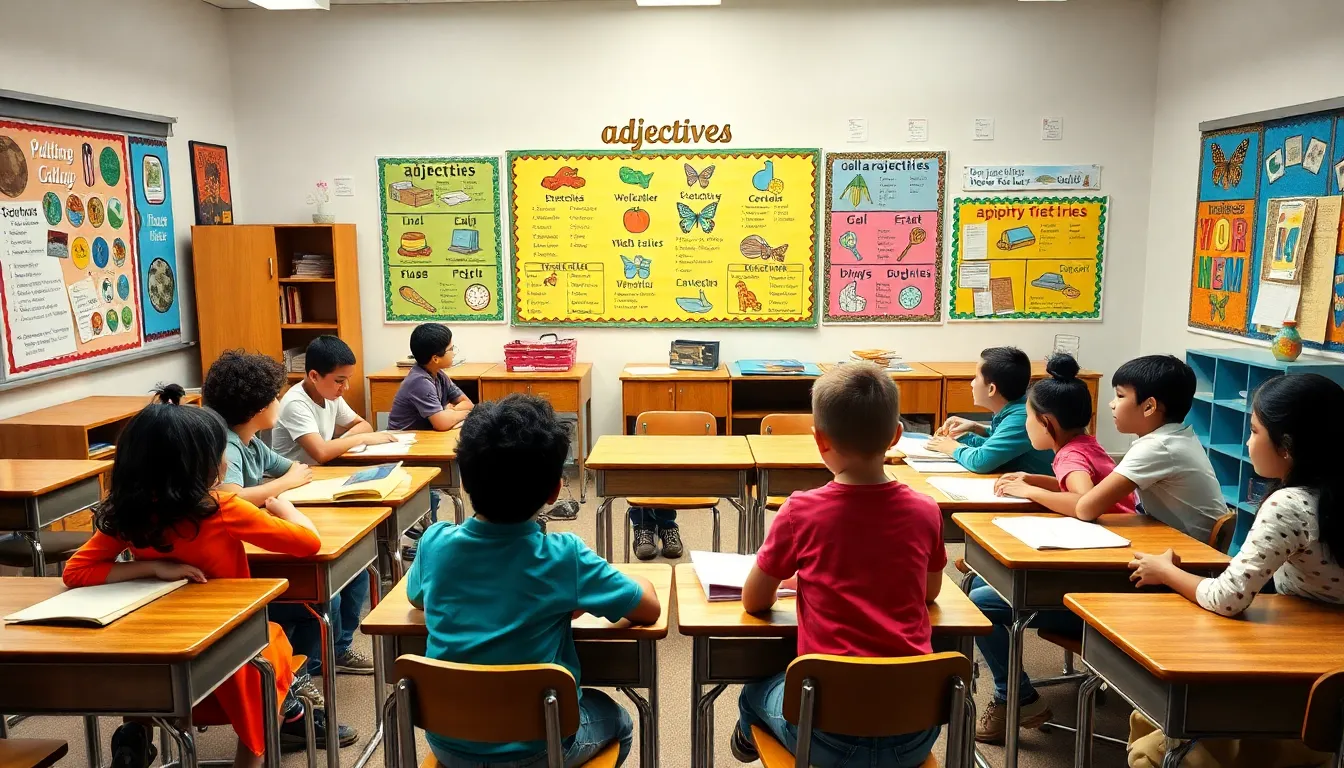
Adjectives come in various types, each serving a unique function in enriching descriptions. Understanding these types helps in using language more effectively.
Descriptive Adjectives
Descriptive adjectives provide detailed information about nouns. They enhance imagery by conveying qualities such as appearance, color, shape, or size. Examples include “the green apple,” “round table,” and “tall building.” These adjectives help the reader visualize the noun, creating a more engaging experience. By using descriptive adjectives, communication becomes clearer and more vivid.
Quantitative Adjectives
Quantitative adjectives indicate the quantity of nouns. They answer questions like how much or how many. Examples include “five apples,” “some water,” and “several cars.” These adjectives help in specifying amounts, making counting easier. By employing quantitative adjectives, clarity improves when discussing quantities in various contexts.
Demonstrative Adjectives
Demonstrative adjectives point out specific nouns. Words such as “this,” “that,” “these,” and “those” serve this purpose. For example, “this book” indicates a nearby item, while “those shoes” refers to items farther away. Demonstrative adjectives guide the listener or reader to the intended subject. By using demonstrative adjectives, one enhances clarity in communication.
Examples of Adjectives in Sentences
Adjectives play a vital role in enhancing sentence clarity and expressiveness. They add depth to language, making descriptions vivid and engaging.
Simple Sentences
Adjectives appear frequently in simple sentences, providing clear information. For example, “The red car zoomed down the street” conveys both color and action. Another instance is “She wore a beautiful dress,” which highlights the elegance of the outfit. “The bright sun shone brightly,” asserts the vividness of the sunlight. Each example demonstrates how adjectives enhance straightforward statements effectively.
Complex Sentences
Complex sentences utilize adjectives to create richer contexts. “Although the storm raged outside, the cozy room felt warm and inviting,” illustrates a contrast using descriptive words. In another case, “The antique desk, covered in dust, revealed stories of the past,” combines attributes with a deeper meaning. “Even though the road was long and winding, the breathtaking view made the journey worthwhile,” showcases how adjectives can enhance understanding in more intricate structures. Each scenario underlines the role of adjectives in conveying detailed imagery.
Common Mistakes with Adjectives
Misplacing adjectives often leads to confusion in descriptions. When adjectives are positioned incorrectly, the intended meaning can become unclear. For instance, saying “the car red is fast” misplaces the adjective, whereas “the red car is fast” clarifies the description.
Overusing adjectives can also dilute their impact. Including too many adjectives in a single phrase may overwhelm the reader. Instead of enhancing a description, phrases like “the big, red, shiny, fast sports car” can result in a cluttered image. Simplifying to “the fast red sports car” maintains vivid imagery while providing clarity.
Confusing adjectives with adverbs is another common error. Adjectives modify nouns, while adverbs modify verbs, adjectives, or other adverbs. For example, one might say “She sings beautiful,” but it’s clearer to express “She sings beautifully.” Correct usage promotes better understanding.
Ignoring comparative and superlative forms can also lead to inaccuracies. For instance, stating “this car is more fast than that one” misuses the adjective. Properly phrasing it as “this car is faster than that one” ensures clarity in comparison.
They can also forget contextual relevance. Choosing adjectives that don’t align with the noun’s characteristic can lead to bland descriptions. Describing a “delicious” rock lacks context and fails to convey an accurate portrayal. Instead, using contextually appropriate adjectives enhances the description significantly.
These mistakes detract from the power of adjectives, which serve to create vivid images in language. Understanding their proper usage enhances communication and fosters clearer, more effective dialogue.
Adjectives play a pivotal role in enhancing language and communication. They bring life to descriptions and allow for more vivid imagery in conversations. By mastering the use of adjectives, individuals can express themselves with greater clarity and creativity.
Understanding the various types of adjectives and their functions is essential for effective communication. Whether describing a scene or expressing an opinion, well-chosen adjectives can significantly impact the listener’s or reader’s experience.
By avoiding common mistakes and utilizing adjectives appropriately, one can elevate their writing and speaking skills. Embracing the richness of adjectives ultimately leads to more engaging and memorable interactions.